$25.95
$51.90
50% OFF! Hot items selling fast—Grab them before they're gone!
 Unconditional Satisfaction GuaranteeNo Shipping Fees Above 302 Months to Decide. Returns Simplified.
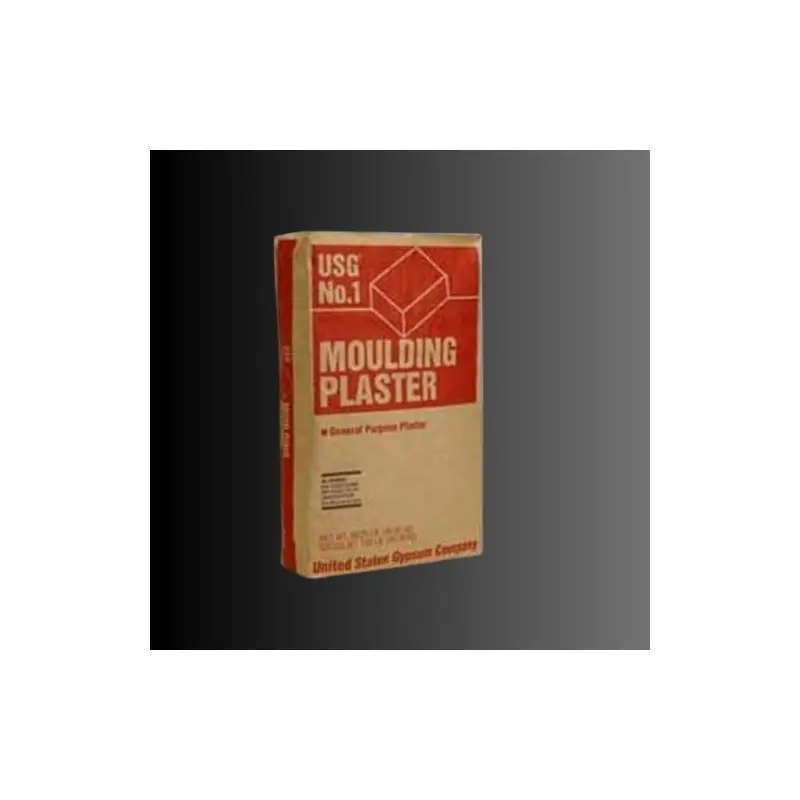
USG #1 MOULDING PLASTER
An ornamental plaster used for creating decorative trim or running cornices.
Moulding plaster is designed for use where expansion control, hardness and strength are not primary considerations.
Often referred to as plaster of Paris or soft plaster, USG No. 1 moulding plaster is used to create waste molds or temporary patterns where surface hardness and strength are not crucial. USG No. 1 moulding plaster:
– See more at: https://www.usg.com/content/usgcom/en/products-solutions/products/industrial-specialty/art-&-statuary/usg-no-1-moulding-plaster.html#sthash.VLqmg0Be.dpuf
– See more at: https://www.usg.com/content/usgcom/en/products-sol…
Almost always one of the lowest cost solutions to your industrial product and process problems or product development opportunities
This USG pottery plaster provides a controllable setting performance few other materials can offer. By adding accelerators or retarders, you can shorten or lengthen its setting time and reproduce setting time from batch to batch.
Controllable setting time . . .
Note: Plaster sets with a sharp, definable, measurable action. It sets fastfaster than typical portland cements and other cementitious materials.
Controllable expansion
Only plaster among cementitious materials offers controllable expansionranging from 0.0005 to 0.0156 in. per in. (or 316 per ft.). Plaster formulations can come closer to zero expansion than many other materials.
Controllable expansion . . .
Ease of Use:
This US Gypsum plaster can be fabricated or used in four main ways:
In fluid slurry form, plaster pours easily into flexible or rigid molds. Viscosity ranges from nearly water to molasses. Plaster captures fine detail and can be parted from any nonporous surface. Properly formulated, it can be self-leveling and pumpable.
In plastic mass form, plaster can be built up, troweled, added to, scraped away, or sculpted as easily as clay. Viscosity ranges from that of butter to modeling clay, or plaster can be applied as a plastic mass to virtually any contourand will set in place to produce a reverse contour.
In solid form, casts from plaster formulation can be carved or machined using conventional tools and equipment, including numerically controlled milling equipment.
Only gypsum among commercial materials possesses extreme ranges in strength, absorption, and density. For example:
This great range occurs by selecting the appropriate plaster formulation, then controlling the amount of mixing water. The graph below indicates how you can obtain this range through predictable control of desired characteristics.
Solubility
Only gypsum among casting materials is selfcleaning in the molda basic requirement in the ceramics industry. What gives gypsum this advantage is its solubility (about two grams per liter of distilled water).
Note: If reduced solubility is not required, gypsum cements can be formulated to meet conditions its that versatile.
Industrial plasters and gypsum cements readily blend with chemicals and aggregates to achieve special properties. Both wet and dry blending are done with various chemicals, powders, and granular materials.
These include: talc iron oxide kaolin resins ball clay asphalt perlite starches sand dyes vermiculite pigments wood fiber polymers foaming agents powdered glue set-time control additives glass/polymer fibers
Compatibility with other chemicals, aggregates
Note: Except for special gypsum cement formulations, do not use coarse aggregates (gravel, stone, rip-rap, or any aggregate larger than 10 mesh) as gypsum crystals do not readily bond to them.
Fire Resistance
Industrial plasters and gypsum cements are noncombustible. With a coefficient of thermal conductivity (k) of 0.25 to 4.0, depending on density and additives, these materials provide a high degree of fire resistance. When exposed to heat, they do not exceed 212 F until threequarters of the chemically combined water is driven off. At about 1800 F the CaSO4 portion dissociates into quicklime (CaO) and sulfur trioxide (SO3). Dry gypsum is electrically nonconductive and makes a good insulating medium.